
Magnesium L-Threonate vs Glycinate: Which Is Better for Sleep?
These statements have not been evaluated by the Food and Drug Administration. This product is not intended to diagnose, treat, cure, or prevent any disease.
If you have a medical emergency or health concern, consult a qualified healthcare professional immediately.
The information in this article is based on currently available scientific research and may evolve as new evidence emerges.
Editorial Disclosure
TideRest Editorial Team does not maintain direct or indirect financial relationships with magnesium supplement manufacturers that would influence the content of this article. Recommendations are based on publicly available research, sleep science literature, and educational analysis.
Introduction
When comparing magnesium L-threonate vs glycinate for sleep, the best option depends on your primary goal.
- Magnesium glycinate is generally preferred for relaxation, stress reduction, and overall sleep support.
- Magnesium L-threonate is more commonly associated with cognitive support, mental clarity, and brain-focused benefits that may indirectly support sleep quality.
Both forms are highly absorbable, but they function somewhat differently inside the body.
For most people seeking a magnesium supplement primarily for sleep, magnesium glycinate is usually the more practical and sleep-oriented option.
This guide explains:
- how each magnesium form works
- the key differences between glycinate and threonate
- sleep and anxiety support potential
- absorption and brain effects
- dosage considerations
- who each option may fit best
What Is Magnesium Glycinate?
Magnesium glycinate is magnesium bound to glycine, an amino acid associated with calming and relaxing properties.
It is one of the most commonly recommended magnesium forms for sleep because it is:
- highly bioavailable
- gentle on digestion
- less likely to cause laxative effects
- commonly associated with relaxation support
Glycine itself may also help support sleep quality and nighttime calmness in some individuals.
Many people choose magnesium glycinate for:
- stress-related sleep issues
- nighttime tension
- difficulty unwinding before bed
- general nervous system support
What Is Magnesium L-Threonate?
Magnesium L-threonate is a newer magnesium form developed to increase magnesium levels in the brain more effectively.
Research interest around magnesium threonate primarily focuses on:
- cognitive function
- memory
- neuroplasticity
- mental clarity
- healthy brain aging
Some individuals also use magnesium L-threonate for sleep because reduced mental overstimulation and calmer cognitive activity may indirectly improve sleep quality.
However, evidence specifically evaluating magnesium L-threonate for sleep remains relatively limited compared to broader magnesium research.
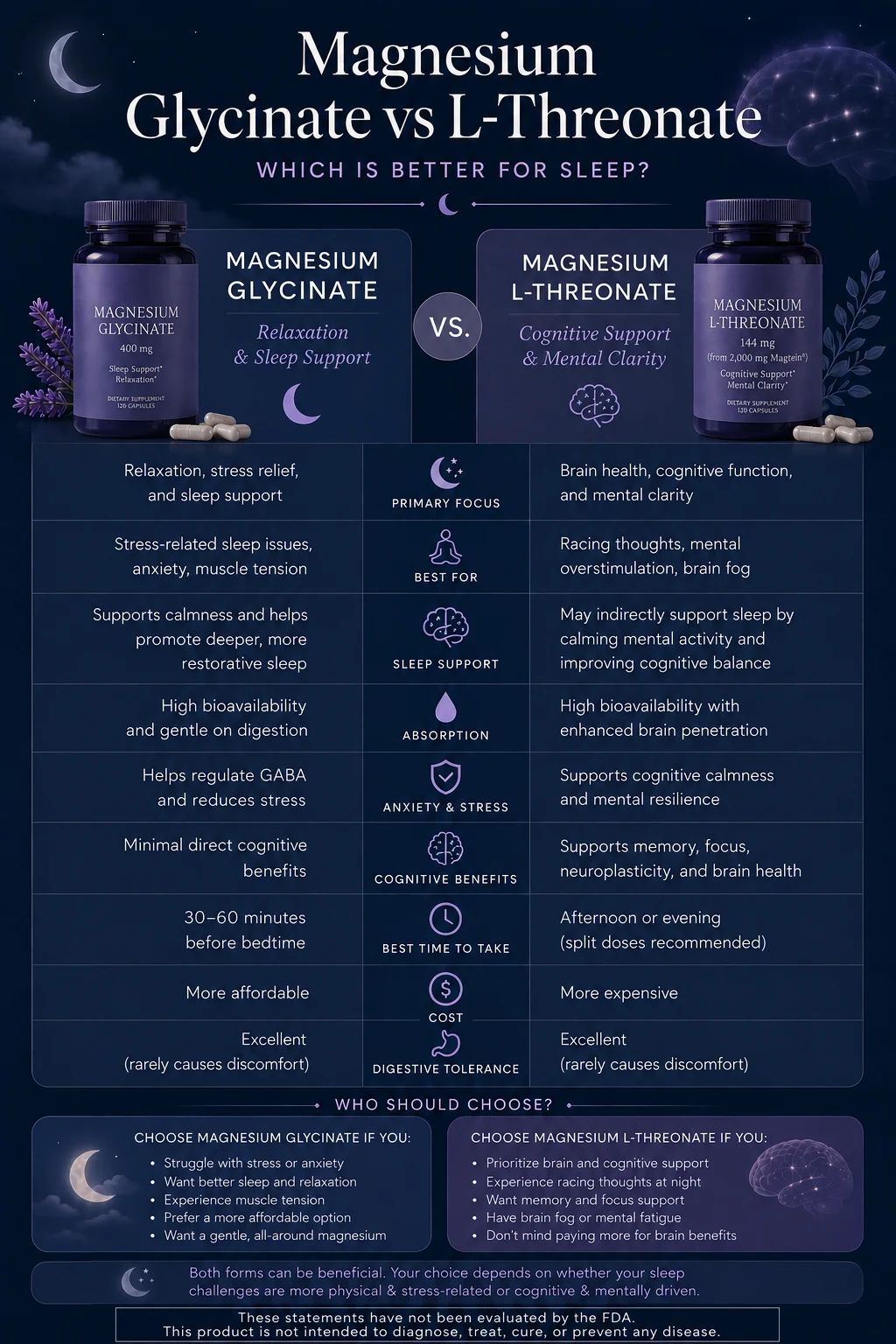
Magnesium L-Threonate vs Glycinate: Quick Comparison
| Feature | Magnesium Glycinate | Magnesium L-Threonate |
|---|---|---|
| Primary Focus | Relaxation & sleep | Brain & cognition |
| Best For | Stress-related sleep issues | Racing thoughts & mental overstimulation |
| Absorption | High | High |
| Brain Penetration | Moderate | Higher |
| Digestive Tolerance | Excellent | Excellent |
| Typical Cost | Lower | Higher |
| Research Focus | Sleep & relaxation | Cognition & memory |
| Common Timing | Evening | Afternoon or evening |
Which Magnesium Is Better for Sleep?
For most sleep-focused users, magnesium glycinate is generally considered the better overall option.
Why Magnesium Glycinate Is Often Preferred
Magnesium glycinate may help support:
- nervous system relaxation
- stress management
- nighttime calmness
- muscle relaxation
- healthy sleep routines
Its connection with glycine gives it a more relaxation-oriented profile than many other magnesium forms.
People commonly choose magnesium glycinate if they experience:
- stress-related insomnia
- nighttime anxiety
- physical tension
- difficulty relaxing before bed
When Magnesium L-Threonate May Be Helpful
Magnesium L-threonate may be more relevant for people whose sleep issues are connected to:
- racing thoughts
- cognitive overstimulation
- mental fatigue
- focus-related stress
- nighttime overthinking
Some users report improved mental calmness and sleep quality while using magnesium threonate, though individual responses vary.
Current evidence for magnesium’s role in sleep is stronger overall than evidence specifically supporting magnesium L-threonate as a dedicated sleep aid.
Absorption and Brain Benefits
One of the biggest differences in the magnesium glycinate vs threonate comparison is brain delivery.
Magnesium L-threonate was specifically designed to increase magnesium concentrations in the brain more efficiently than many traditional magnesium forms.
This has generated interest around its potential role in:
- memory support
- cognitive performance
- neuroplasticity
- healthy aging
Magnesium glycinate, meanwhile, is more commonly associated with:
- systemic relaxation
- nervous system support
- stress management
- evening calmness
For many users, the difference comes down to:
- physical relaxation → glycinate
- cognitive calmness → threonate
Magnesium for Anxiety and Stress
Many people searching for the best magnesium type for sleep are also looking for stress or anxiety support.
Magnesium Glycinate
Magnesium glycinate is frequently used for:
- relaxation support
- stress management
- evening calmness
- nervous system balance
Because glycine may have calming properties, glycinate is often viewed as a gentler nighttime magnesium option.
Magnesium L-Threonate
Magnesium L-threonate may appeal more to individuals experiencing:
- mental fatigue
- cognitive overload
- excessive mental stimulation
- focus-related stress
It is often viewed as more “brain-focused” than “body relaxation-focused.”
Dosage Comparison
Magnesium Glycinate
Typical supplemental range:
- 200–400 mg elemental magnesium daily
Common timing:
- 30–60 minutes before bed
Magnesium L-Threonate
Typical intake:
- branded formulations often provide roughly 144 mg elemental magnesium daily
Common timing:
- split between afternoon and evening doses
Because magnesium L-threonate contains less elemental magnesium by weight, serving sizes may appear larger on supplement labels.
Individual magnesium needs may vary depending on diet, stress levels, health status, and baseline magnesium intake.
Side Effects and Safety
Both magnesium glycinate and magnesium L-threonate are generally well tolerated when used appropriately.
Magnesium Glycinate
Possible side effects may include:
- mild drowsiness
- occasional digestive discomfort
Magnesium L-Threonate
Possible side effects may include:
- headaches in some individuals
- vivid dreams
- mild digestive sensitivity
People with kidney disease, underlying medical conditions, or those taking medications should consult a healthcare professional before starting magnesium supplementation.
Can You Take Magnesium Glycinate and L-Threonate Together?
Some individuals combine both forms as part of a broader wellness routine.
A common approach includes:
- magnesium L-threonate earlier in the day for cognitive support
- magnesium glycinate in the evening for relaxation support
However, total magnesium intake still matters.
Excessive magnesium supplementation may increase the risk of digestive discomfort or medication interactions.
How to Choose a High-Quality Magnesium Supplement
When comparing magnesium supplements, look for:
- transparent elemental magnesium labeling
- third-party testing
- reputable manufacturing standards
- clearly identified magnesium forms
- minimal unnecessary fillers
Avoid products that:
- use proprietary blends without clear dosing
- make exaggerated sleep claims
- hide ingredient quantities
Final Verdict

In the magnesium L-threonate vs glycinate comparison, magnesium glycinate is usually the better overall choice for sleep-focused support.
It is:
- more directly associated with relaxation
- widely used for stress-related sleep support
- easier to integrate into nighttime routines
- generally more affordable
Magnesium L-threonate may still be valuable for individuals prioritizing:
- cognitive support
- mental clarity
- focus
- brain-focused wellness goals
The best magnesium type for sleep ultimately depends on whether your sleep challenges are more:
- physical and stress-related
or - cognitive and mentally driven
Calm Nighttime Support Without Melatonin
At TideRest, we focus on evidence-based sleep support designed around:
- nervous system calmness
- practical nightly routines
- non-melatonin sleep optimization
- long-term sleep wellness
Explore related guides:
- Magnesium Glycinate for Sleep
- Best Magnesium for Sleep
- Sleep Supplements Without Melatonin
- Natural Alternatives to Melatonin
- When to Take Magnesium for Sleep
❓ FAQ
 References
- National Institutes of Health (NIH)
Magnesium Fact Sheet for Health Professionals
https://ods.od.nih.gov/factsheets/Magnesium-HealthProfessional/ - Sleep Foundation
Magnesium and Sleep
https://www.sleepfoundation.org/magnesium - Abbasi B, et al.
Effect of magnesium supplementation on primary insomnia in elderly
Journal of Research in Medical Sciences (2012)
https://www.ncbi.nlm.nih.gov/pmc/articles/PMC3703169/ - Ranade VV, Somberg JC.
Bioavailability and pharmacokinetics of magnesium after administration of magnesium salts to humans
American Journal of Therapeutics (2001) - Rondanelli M, et al.
Self-care for common colds: the pivotal role of vitamin D, vitamin C, zinc, and Echinacea in three main immune interactive clusters
Evidence-based discussion including magnesium and nervous system regulation
Evidence-Based Complementary and Alternative Medicine (2018)
 Final Compliance Note
This content is for informational purposes only and does not constitute medical advice. Dietary supplements may affect individuals differently depending on health status, medications, and lifestyle factors. Consult a qualified healthcare professional before starting any supplement routine.